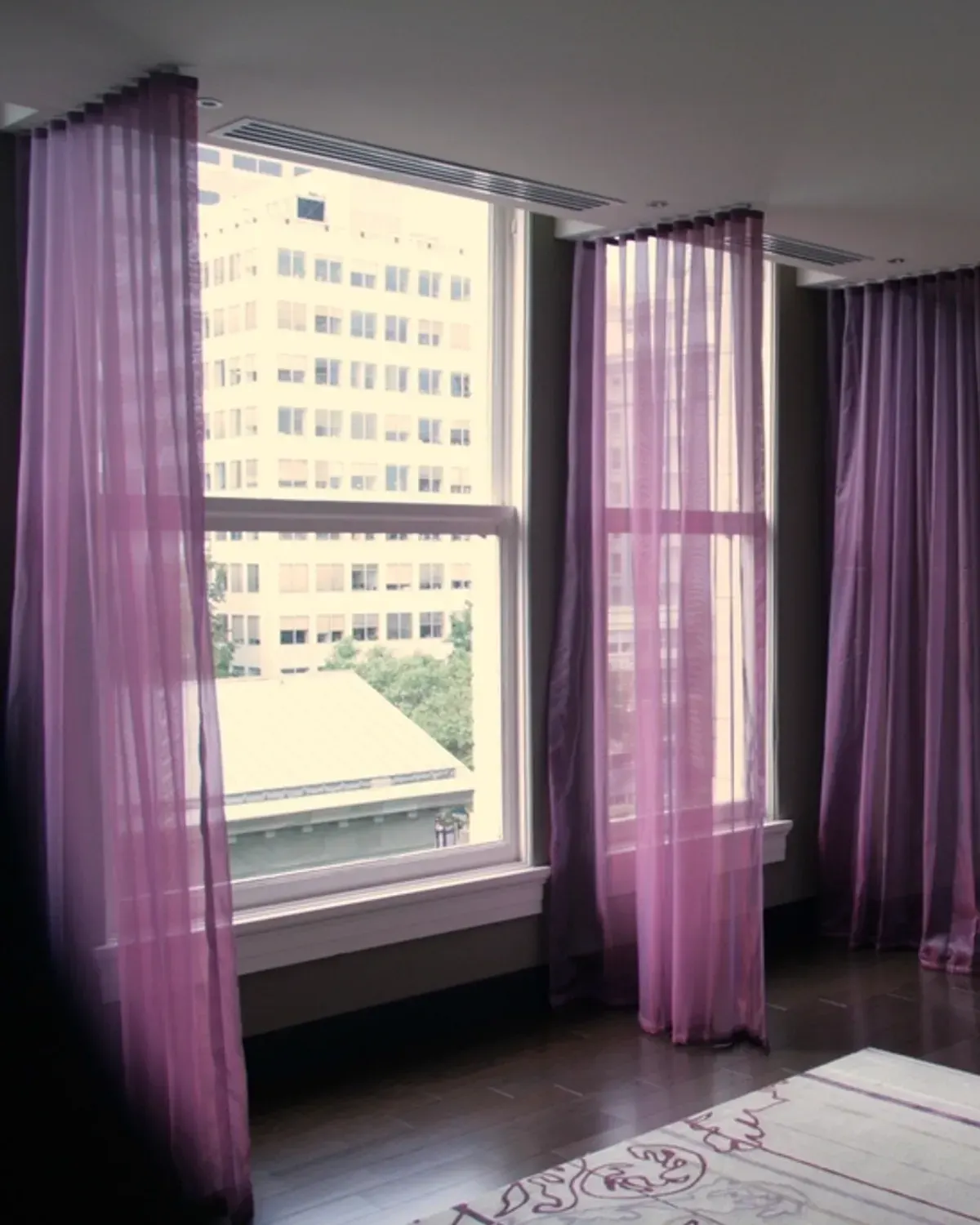
Hang curtains high and wide
The designer rule for hanging curtains that make windows look bigger and ceilings taller — rod height, rod width, panel length and fullness, with real numbers.
What it costs
| Extendable curtain rod, 48–144 in | $20 |
| Two linen-look panels, 96 in | $35 |
| Curtain rings with clips (14) | $10 |
| Total | $65 |
Rough US prices at the time of review. Prices change — check before you buy, and skip what you already own.
Hang the rod halfway between the window frame and the ceiling (or 2–4 inches below the ceiling), extend it 8–10 inches past each side of the window, and buy panels that just touch the floor.
If you only change one thing in a small room, make it the curtains. Hung right, they make the window look twice as big and the ceiling look taller — and the whole thing costs about $65. Hung wrong (right on top of the window frame, too short, too narrow), they make the room look smaller than it is.
Want the numbers for your own window? Use our rug size & curtain height calculator.
Rule 1: Hang the rod high
The classic mistake is mounting the rod right on top of the window frame. Instead:
- Ideal: halfway between the top of the window frame and the ceiling, or higher.
- For a big gap (more than about 8 inches): go up to 2–4 inches below the ceiling.
- Crown molding? Mount just below it.
Your eye follows the fabric from the floor all the way up, and the ceiling suddenly looks taller.
Rule 2: Hang the rod wide
Extend the rod 8–10 inches past each side of the window frame (up to 12 inches for wide windows). When the curtains are open, they rest on the wall instead of covering the glass. That does two things: the window looks wider, and you get all the daylight.
Rule 3: Let the curtains kiss the floor
Measure from the rod (or from the bottom of the rings if you use them) down to the floor. Subtract about half an inch. That’s your ideal length.
| Rod height from the floor | Panel length to buy |
|---|---|
| Up to 85 in | 84 in |
| 85–97 in | 96 in (sometimes sold as 95) |
| 97–109 in | 108 in |
| 109–121 in | 120 in |
Between sizes? Buy the next length up and use clip rings to raise it, or hem it with iron-on tape. Curtains that stop above the floor (“high waters”) are the number one thing that makes curtains look cheap.
Rule 4: Go fuller than you think
Flat curtains look skimpy. The total width of your panels should be about 2 to 2.5 times the rod length. For a 60-inch rod, that’s 120–150 inches of fabric — usually three panels of 50–54 inches, not two.
Rule 5: Pick light, textured fabric
In a small room, linen-look or cotton in white, oatmeal or a color close to your walls works best. It blends with the walls and makes the room feel bigger. Want darkness in a bedroom? Add a blackout liner behind it.
Three windows, worked out
All three assume curtains hung “high and wide” and panels that just touch the floor.
| Window | Rod height | Rod width | Panel length | Panels (50–54 in wide) |
|---|---|---|---|---|
| 36 in wide, frame top at 80 in, 8 ft (96 in) ceiling | 93 in (3 in below the ceiling) | 54 in | 96 in, lifted 3.5 in with clip rings | 3 |
| 48 in wide, frame top at 82 in, 8 ft ceiling | 93 in | 66 in | 96 in | 3 |
| 72 in sliding door, top at 80 in, 9 ft (108 in) ceiling | 105 in | 90 in | 108 in, lifted 3.5 in with clip rings | 4 |
Get your own numbers in seconds with the rug & curtain calculator.
Step by step: hanging the rod
You need: tape measure, pencil, level (or a level app), drill, the brackets and screws that came with the rod, and drywall anchors if you can’t hit a stud.
- Mark the height. Measure up from the floor (not from the window) to your rod height on both sides. Floors and windows are often not level; the floor is what the curtains have to meet.
- Mark the width. From each side of the window frame, measure 8–10 inches out. That’s where the outer brackets go.
- Check with the level that both marks line up.
- Find studs with a stud finder, or use the anchors in the box. Above most windows there’s a solid header, so screws often bite well there.
- Add a center bracket if the rod is longer than about 60–72 inches or the curtains are heavy (blackout, velvet) — otherwise the rod sags in the middle.
- Hang the panels and adjust. If they’re a little long, raise them with clip rings; a little short, lower the rod. Aim for the hem to just touch the floor.
Fabric: what to buy
| Fabric | Typical price (2 panels, 96 in) | Light | Best for |
|---|---|---|---|
| Linen-look polyester | ~$25–$40 | Filters | Living rooms; cheap and wrinkle-resistant |
| Cotton or real linen | ~$60–$150 | Filters | A softer, more expensive look |
| Sheer | ~$20–$35 | Lets most light in | Layering, dark rooms |
| Blackout (or a blackout liner) | ~$35–$60 | Blocks | Bedrooms, street-facing windows |
In a small room, pick a color close to the walls. Contrasting curtains frame the window but “cut” the wall; matching ones make it disappear.
Tricky windows
- Radiator or heater under the window: use sill-length panels (or tie floor-length ones back during the heating season). Never let fabric rest on a heater.
- Window right next to a corner: extend the rod only on the open side, and use one panel that stacks toward the corner.
- Window that reaches almost to the ceiling: use ceiling-mount brackets or a ceiling track — there’s no room above the frame.
- Two windows on one wall: one long rod across both makes the wall look like one big window.
Curtains for a whole apartment: a real budget
A one-bedroom with three windows: two 48-inch windows in the living room and one 36-inch window in the bedroom, 8-ft ceilings.
| Window | Rod | Panels | Cost |
|---|---|---|---|
| Living room, 2 windows on one wall | One long rod (120 in) across both, center bracket | 4 linen-look panels, 96 in | ~$30 rod + ~$70 panels |
| Bedroom | 54 in of rod (a 48–84 in adjustable rod) | 3 blackout panels, 96 in | ~$20 rod + ~$60 panels |
| Clip rings, anchors | — | — | ~$15 |
| Total | ~$195 |
One long rod across two windows on the same wall makes them read as one big window — the single best trick for a living room with two small windows.
Measuring mistakes to avoid
- Measuring from the window instead of the floor. Window frames are often not level; the hem has to meet the floor.
- Forgetting the rings. Rings add 1–2 inches between the rod and the top of the curtain. Measure to the bottom of the ring.
- Ignoring the stack. Open curtains need room to “stack” beside the window — usually 8–12 inches per side for two panels. That’s why the rod goes wide.
- Buying by window width only. Panel width is about fullness, not coverage: 2–2.5 times the rod.
What it costs
| What | Price |
|---|---|
| Extendable rod | ~$20 |
| Two 96-in linen-look panels | ~$35 |
| Clip rings | ~$10 |
| Total | ~$65 |
Too long? Hem without sewing
Curtains a few inches too long are easy to fix:
- Hang them first and let them settle for a day.
- Pin the hem where it just touches the floor.
- Iron-on hem tape (~$5): fold up the extra fabric, slide the tape inside, press with a hot iron following the tape’s instructions.
- Or use clip rings to raise the whole panel 1–3 inches — no cutting at all, and you can undo it in the next apartment.
Blinds and curtains together
Keep the blinds (landlords usually want them to stay) and hang the curtains high and wide in front of them. During the day, raise the blinds all the way and let the curtains frame the window; at night, the blinds give privacy and the curtains add warmth. Make sure the blind cords are tied up out of reach if there are kids at home.
Renter notes
Two screw holes per bracket are normal wear in most leases. Fill them with spackle when you move out. Can’t drill at all? Tension rods inside the frame are the fallback — or use adhesive rod hooks for light sheers.
Cords and kids
If there are young children at home, pick cordless blinds and wand-operated curtains. Dangling window-covering cords are a strangulation hazard, and the CPSC recommends cordless products in homes with young kids. Curtains on a rod with rings have no cords at all — one more reason to skip the blinds.
Common mistakes
- Rod on the frame. Lowers the ceiling visually.
- Rod the same width as the window. Curtains cover the glass and block light.
- Too short. Stops above the floor and looks unfinished.
- Too few panels. Looks flat and stretched.
More tricks in 9 ways to make a small room look bigger.
Sources
Quick answers
Should curtains touch the floor?
Yes, for a tailored look they should just touch it (or be within about half an inch). Curtains that stop above the floor make windows and ceilings look shorter.
Can I use a tension rod for floor-length curtains?
Only inside the window frame, which defeats 'high and wide.' For floor-length curtains on the wall, a bracket-mounted rod is the reliable choice.
How high should I hang curtains?
Mount the rod about halfway between the top of the window frame and the ceiling, or 2–4 inches below the ceiling if there is a big gap. Never right on top of the frame.
How far past the window should a curtain rod go?
Extend the rod 8–10 inches past each side of the window frame so the open curtains rest on the wall, not over the glass. This makes the window look wider and lets in more light.
What length curtains do I need?
Measure from the rod (or the bottom of the rings) to the floor and subtract half an inch so the panels just kiss the floor. Standard lengths are 84, 96, 108 and 120 inches.
How wide should curtains be?
For a full look, the total width of all panels should be about 2 to 2.5 times the length of the rod.
Save it to Pinterest
Saw the video? Comment CURTAIN on our posts and we'll send you this link.
Save to Pinterest